Find your ring size
Getting the size right the first time saves a fortnight. Two ways to find it at home, both accurate to about half a size — and if you are between two, take the larger one.
You will need a ruler. Any ruler with millimetres on it. Do not measure against the screen — a screen cannot know how big it is, and it will be wrong by about a size.
If you have a ring that already fits
-
Pick the right ring
One that is worn on the finger you are buying for. Fingers differ by a size or more between hands, and the same finger differs between them.
-
Measure straight across the inside
Lay the ring flat on the ruler and read the widest distance from the inside of one edge to the inside of the other. That is the inside diameter — about 16 to 18 mm for most people.
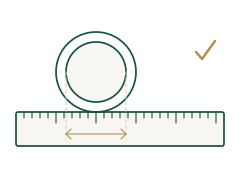
-
Not across the outside
This is the one mistake worth a picture of its own. The outside of a band is a size and a half bigger than the inside, more on a wide band, and the ring that arrives will fall off.
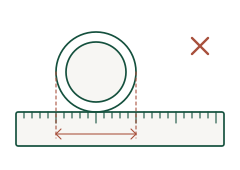
If you do not
-
Cut a strip of paper
About 6 mm wide and long enough to go round the finger with some to spare. Paper, not thread — thread stretches, and a stretched measurement is a ring that does not go on.
-
Wrap it round the base and mark it
Round the base of the finger, snug but not tight — you should be able to turn it. Mark where the strip meets itself. If your knuckle is larger than the base, check the strip still slides over it before you settle.
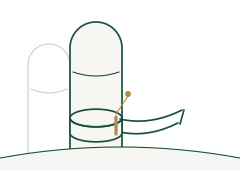
-
Lay it flat on the ruler
Read the millimetres from the end of the strip to your mark. That is the inside circumference — about 50 to 58 mm for most people.
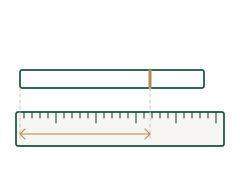
Your measurement
Indian and US sizes
Indian sizes are the ones we make in. They step about 1 mm at a time, and US sizes step about 1.3 mm, so a US number sometimes covers two Indian ones — that is the two scales, not a mistake.
| Indian | Inside diameter | Inside circumference | US (approx.) |
|---|---|---|---|
| 1 | 13.1 mm | 41 mm | 1.5 |
| 2 | 13.4 mm | 42 mm | 2 |
| 3 | 13.7 mm | 43 mm | 2.5 |
| 4 | 14 mm | 44 mm | 3 |
| 5 | 14.3 mm | 45 mm | 3.5 |
| 6 | 14.6 mm | 46 mm | 3.5 |
| 7 | 15 mm | 47 mm | 4 |
| 8 | 15.3 mm | 48 mm | 4.5 |
| 9 | 15.6 mm | 49 mm | 5 |
| 10 | 15.9 mm | 50 mm | 5.5 |
| 11 | 16.2 mm | 51 mm | 5.5 |
| 12 | 16.6 mm | 52 mm | 6 |
| 13 | 16.9 mm | 53 mm | 6.5 |
| 14 | 17.2 mm | 54 mm | 7 |
| 15 | 17.5 mm | 55 mm | 7 |
| 16 | 17.8 mm | 56 mm | 7.5 |
| 17 | 18.1 mm | 57 mm | 8 |
| 18 | 18.5 mm | 58 mm | 8.5 |
| 19 | 18.8 mm | 59 mm | 9 |
| 20 | 19.1 mm | 60 mm | 9 |
| 21 | 19.4 mm | 61 mm | 9.5 |
| 22 | 19.7 mm | 62 mm | 10 |
| 23 | 20.1 mm | 63 mm | 10.5 |
| 24 | 20.4 mm | 64 mm | 11 |
| 25 | 20.7 mm | 65 mm | 11 |
| 26 | 21 mm | 66 mm | 11.5 |
| 27 | 21.3 mm | 67 mm | 12 |
| 28 | 21.6 mm | 68 mm | 12.5 |
| 29 | 22 mm | 69 mm | 12.5 |
| 30 | 22.3 mm | 70 mm | 13 |
US sizes are a conversion and are marked approximate because that is what they are — published charts disagree with each other by about half a size. The Indian number is the one your ring is made to.
Two things worth knowing
- Measure in the evening. Fingers are at their largest then. A ring that only fits in the morning is a ring that comes back.
- Between two sizes, take the larger. A ring that is slightly loose can be worn while it is resized. One that will not go on cannot.
Fingers change size through the day and with the weather. Measure in the evening, at room temperature, and measure the hand the ring will be worn on.